








From consultation to production-ready AI-supported software
10+ Years of AI Experience
AI@G+D Netcetera has been delivering cutting-edge AI solutions for over a decade.
Specialized AI Talent
We have assembled a team of AI engineers and domain experts who bring a wealth of experience in developing advanced AI systems.
Proven Track Record
Our track record in AI spans regulated, security-critical industries — with deep specialization in banking, payments, and financial technologies.
Comprehensive AI Capabilities
We have deep experience in LLMs and agentic systems as well as machine learning methods such as time series analysis, anomaly detection.
Agentic AI
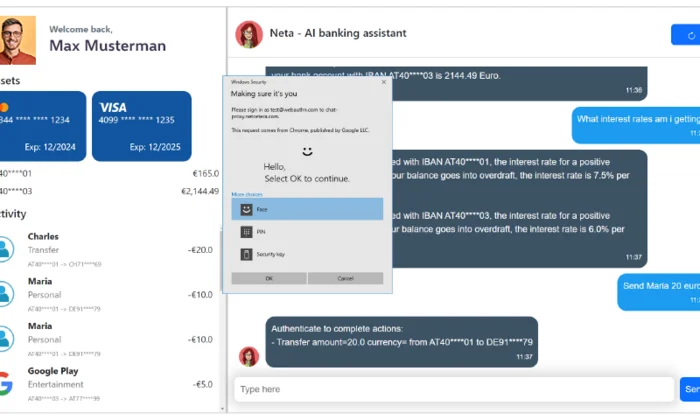
An AI banking assistant that goes beyond conversational Q&A. Connected to core banking systems via the Model Context Protocol (MCP), it can retrieve account information, deliver personalized spending insights, and execute actions — like blocking a card or initiating a transfer — directly through a natural language interface.
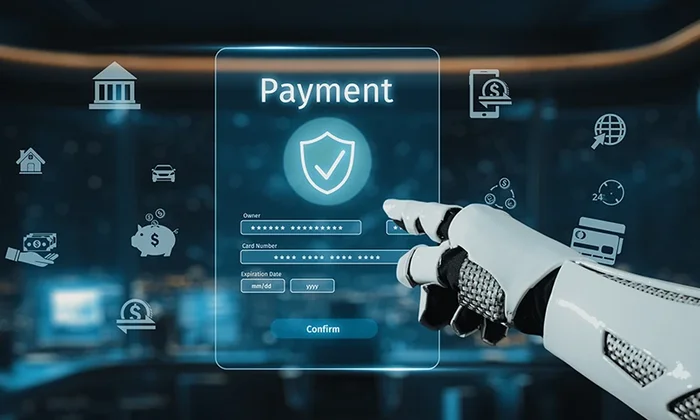
Integrating payment APIs — 3-D Secure, Click To Pay, tokenization — is complex and documentation-heavy. Our AI-powered integration assistant gives developers a natural language interface to discover APIs, test in sandboxes, and generate integration code.
By reducing integration friction and accelerating time-to-production, the assistant transforms the developer experience for payment service providers and their merchant clients.
Document intelligence
DocDive is an enterprise-grade document intelligence platform that transforms how organizations interact with their knowledge. Built on open-source technology, DocDive enables intelligent search, summarization, and data extraction across thousands of documents — from PDFs and databases to FAQs and web content.
What sets DocDive apart: full on-premise deployment for organizations where cloud isn't an option and secure integration with external data sources via MCP (Model Context Protocol).
Large financial institutions publish hundreds of IT bulletins annually — Java version decommissions, API deprecations, infrastructure migrations, system replacements. Manually assessing which teams, systems, and projects are affected consumes thousands of person-days every year.
Impact IQ automates this entirely. It ingests IT change announcements, analyzes them against your system landscape, and identifies impacted teams and components — delivering targeted notifications instead of organization-wide noise.
Banks are constrained by legacy systems that absorb most IT spend, slow modernization, increase risk, and limit their ability to compete and innovate. LegacyLift allows controlled, scalable legacy modernization for banks - without sacrificing stability, compliance, or code integrity.
Machine learning
350 million people globally suffer from over 10,000 genetic disorders and rare diseases, with fewer than 500 having approved treatments. G+D Netcetera's Phivea® platform with Gmendel addresses this challenge using advanced AI and customized deep learning for accurate diagnosis and real-time clinical intervention prediction.
Phivea aims to revolutionize genetic analysis within existing healthcare protocols, improving accessibility and outcomes.
Healthcare insurance faces up to 30% higher costs due to fraudulent claims, leading to significant financial losses. Traditional rule-based approaches to combat waste, abuse, and fraud are limited, missing cases that should be rejected.
G+D Netcetera's RISIC, a machine learning-based solution, doubles savings rates by detecting fraudulent claims. Its predictive analysis is flexible and outcome-focused, overcoming the limitations of rules-based systems.
Services
AI strategy and use case discovery
We identify where AI creates measurable value in your financial services operations, validated against business cases before any code is written.
Data engineering for regulated industries
We handle data that requires Swiss/EU compliance, GDPR, and FINMA-grade data governance from day one.
From PoC to production
Our AI solutions run in production environments with the reliability, security, and auditability that financial institutions require.
Scaling and secure integration
We push AI-driven software into production systems ensuring security, data protection and business relevance through seamless embedding in existing systems and workflows.
FAQs
Which AI use cases deliver the fastest ROI for banks and financial institutions?
We typically see fastest ROI in use cases that remove friction or manual work at scale: AI-powered customer service assistants that resolve standard queries, document intelligence for KYC, credit, and compliance documentation, AI copilots for developers. These use cases build on existing processes and data, so they can be piloted quickly and scaled once value is proven.
Which AI solutions ensure data protection, privacy, and compliance?
All AI solutions are designed with security and compliance as a baseline, not an afterthought. We follow data minimization and privacy-by-design principles, support data residency requirements, and implement strict access controls, encryption, and logging across the full lifecycle. For regulated clients, we align architecture and processes with relevant frameworks (e.g. GDPR, FINMA, EBA guidelines) and provide the documentation needed for internal and external audits.
Which AI solutions run fully on‑premise or in private clouds?
Many of our customers operate in highly regulated environments where public cloud is limited or excluded, so we support deployment on-premise, in private cloud, or in hybrid models. We work with your internal infrastructure and security teams to define the right deployment architecture, including integration with your identity and access management, monitoring, and backup and disaster recovery setups.
How do you securely connect AI agents to our core systems and APIs?
We use standard integration patterns and protocols, such as secure APIs, service meshes, and the Model Context Protocol (MCP), to connect AI agents to your systems in a controlled way. Access is governed through your existing identity and authorization mechanisms, and every action taken by an AI agent is logged and auditable. This approach lets you expose only the necessary capabilities and data, while maintaining security boundaries and separation of duties.
How do you move AI from proof of concept to production‑ready use?
We start with a clearly defined use case and success metrics before building a proof of concept on realistic data. Once the concept is validated, we harden the solution for production: improving robustness and performance, adding monitoring and alerting, implementing governance and security controls, and integrating with your processes and systems. Our teams bring experience from multiple production deployments, so the goal is always to avoid “prototype graveyards” and focus on solutions that run reliably in day-to-day operations.
How do you govern, audit, and explain AI models in regulated environments?
We implement model governance across the lifecycle: from documented requirements and training data lineage to versioning, validation, and change management. Depending on the use case, we combine explainable AI techniques, model cards, and clear decision logs so that decisions can be traced and justified. This gives internal stakeholders, auditors, and regulators the transparency they need, while still allowing you to innovate with advanced AI technologies.
Which AI capabilities do you offer, and when do you use each?
We cover the full spectrum from large language models and agentic systems, through document intelligence and enterprise search, to classic machine learning for prediction, classification, and anomaly detection. LLMs and agents are ideal for natural language interactions and orchestration of complex workflows; document intelligence shines where unstructured documents dominate; and specialized ML models excel where high precision, stability, and explainability are essential, for example in fraud detection or risk scoring. We help you select the right technology mix for each business problem rather than forcing one approach everywhere.
How do you collaborate with our IT and data teams on AI projects?
We see AI as a joint effort, not an external black box. Typically, your business stakeholders define goals and requirements, IT and data teams provide access to systems and data, and we bring AI architecture, engineering, and delivery expertise. We work in agile setups with mixed teams, transparent backlogs, and regular reviews, so that your organization builds internal know-how and can operate and evolve the solution after go-live.
How does your AI offering complement existing hyperscaler AI services?
We build on, rather than compete with, hyperscaler services. Our role is to design and implement end-to-end, domain-specific solutions that combine your data, your systems, and the best-fitting AI components, whether they run on-premise or in the cloud. This includes orchestrating multiple models, adding guardrails, security and compliance layers, and integrating AI deeply into your banking, payments, or healthcare workflows so you get differentiated value beyond out-of-the-box tools.
Related resources
Podcast: What AI agents can actually do for banking today
In this episode of Future Proof, Carsten Wengel speaks with Fabio Strässle, Head of the AI Centre of Excellence at G+D Netcetera, about the reality of agentic AI in financial services.
Podcast: AI transformation in financial services
In this episode of Future Proof, CTO Corsin Decurtins explores with host and CEO Carsten Wengel, how AI is transforming software development in financial services. They separate reality from hype.