Why European banks need AI-powered legacy modernization now
Many core banking and payment systems still run on technologies introduced decades ago. While these systems remain operationally critical, maintaining and evolving them has become increasingly difficult, costly, and dependent on institutional knowledge held by a small number of specialists.
That expertise is disappearing.
At the same time, modernization pressure is accelerating. DORA is reshaping operational resilience requirements. Customers expect real-time digital services. Payment ecosystems are evolving toward new standards and architectures.
AI is fundamentally changing how quickly legacy systems can be understood, documented, and modernized and reducing the operational risk of acting too late.
How AI changes legacy banking system modernization
AI-powered legacy modernization in four phases
Understand
We analyze the existing systems, including the codebase, architecture, data flows, integration dependencies, and business logic accumulated through years of operational exceptions and adaptations.
AI accelerates this analysis from years to weeks. The result is a documented view of how the system works, often the first complete picture the institution has ever had.
Deliverables: Business logic documentation, dependency mapping, and migration roadmap options
Plan
Based on the analysis, we define a modular modernization roadmap identifying which components should be modernized, which should remain stable, and which can be retired entirely.
Each phase is designed to deliver measurable value independently, allowing banks to realize operational benefits before the overall transformation is complete.
Deliverables: Phased modernization roadmap with business case, sequencing strategy, and risk profile for each phase
Deliver
New components are built and validated in parallel with the existing system. Modernized components go live incrementally, while legacy systems stay operational until replacements are fully proven. AI-assisted development supports code generation, testing, and documentation throughout.
Security and compliance: PCI-DSS and DORA validation integrated into every phase
Deliverables: Production-ready components delivered incrementally throughout the program
Operate and evolve
We operate the systems we build under the same security and resilience standards required of critical financial infrastructure.
Because the system was documented from the beginning, operational knowledge remains embedded in the platform itself rather than concentrated in individual teams.
Operations: SLAs aligned with DORA operational resilience requirements
Deliverables: Modernized operational systems with continuously maintained documentation
AI-enabled delivery built for regulated financial environments
Code analysis, testing, migration support, and documentation generation all operate within controlled environments, with outputs continuously validated by engineers experienced in PCI-DSS, DORA, eIDAS 2.0, and regulated banking architectures.
This is not a traditional delivery model with AI added on top. Security, resilience, and compliance are integrated into the engineering process itself.
Our advantage is not simply the use of AI. It is the combination of AI-enabled delivery with decades of experience building and operating payment, banking, and digital identity systems under real-world regulatory and operational constraints.

AI Center of Excellence timeline
The team focuses on applying AI to practical challenges in regulated industries, including banking, payments, healthcare diagnostics, fraud detection, and document processing.
Since 2015
AI and machine learning projects in healthcare, mobility, and finance — establishing core expertise in regulated industries before the LLM wave.
2019
Machine learning for rail network disruption prediction — SBB Flatland Challenge.
2020-2021
Phivea® AI platform for genetic disorder diagnosis, in collaboration with University Children's Hospital Zurich. Golden Egg Award finalist.
2022-2023
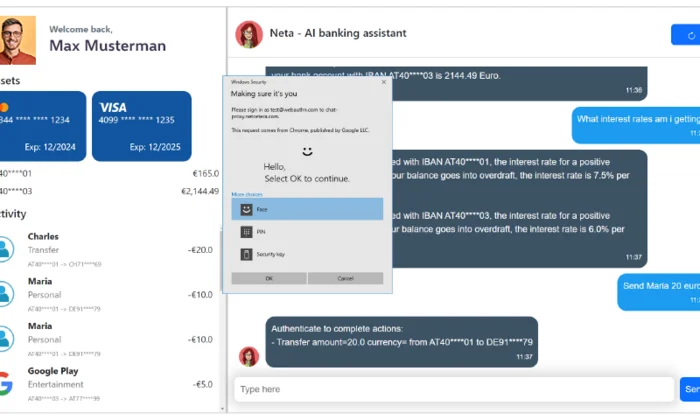
AI Banking Assistant and DocDive platform launched. Agentic document intelligence in live production for financial clients.
2024
AI Center of Excellence formally established.
2025
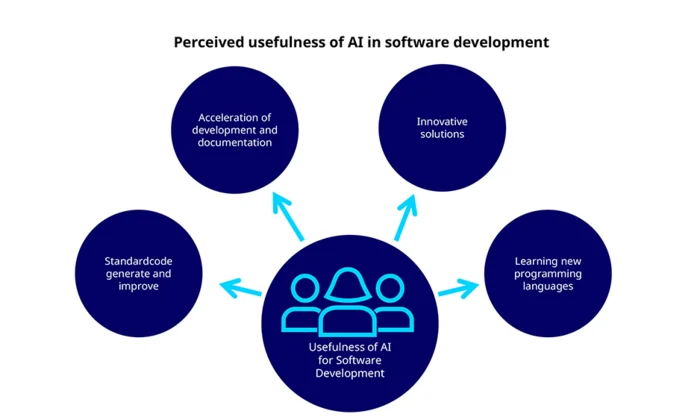
AI in software development: 2025 study with G+D, appliedAI, and WeAreDevelopers
2025-2026
Agentic workflows, MCP-secured AI integration, legacy lift deployments at scale for European financial institutions.
2026
AI-assisted delivery in practice: reducing risk and manual effort in IT impact analysis for one of Switzerland’s largest banks, and building a customer-facing AI assistant for personalized financial insights at an Icelandic bank.
![]()
"The capabilities of modern AI systems are rarely the bottleneck anymore. The real challenge is making them scalable, secure, and compliant. Particularly in regulated industries like financial services. This is where G+D Netcetera's decades of experience building solutions to the highest security standards becomes a genuine advantage.”
FAQs
What is AI-powered legacy modernization for banks?
AI-powered legacy modernization uses artificial intelligence to analyze existing banking systems, including COBOL, assembler, and other legacy codebases.
AI helps reconstruct undocumented business logic, identify dependencies and service boundaries, and support the generation of modern code equivalents. This significantly reduces the time required for analysis and migration compared to traditional manual approaches.
Can banks modernize COBOL systems without replacing the entire core?
Yes. G+D Netcetera uses an incremental modernization approach in which systems are modernized module by module.
Each component is validated against production behavior before rollout, while the existing system remains operational throughout the process. This reduces operational risk and allows individual modernization phases to deliver value independently.
How long does AI-assisted legacy modernization take?
Traditional manual analysis often requires several months. AI-assisted analysis reduces this to weeks. Overall modernization timelines depend on the number and complexity of components. The phased approach allows banks to see measurable progress early in the program.
How does G+D Netcetera ensure AI tools do not create security or compliance risks?
All AI tools used during delivery operate under the same governance and security standards as the production systems being modernized.
Sensitive data remains within controlled environments, and all AI-generated outputs are reviewed by engineers experienced in PCI-DSS, DORA, and European banking compliance before production deployment.
How does AI in software delivery relate to G+D Netcetera's AI banking products?
These are separate offerings.
G+D Netcetera’s AI products, including AI Banking Assistant or Impact IQ, are solutions used by financial institutions in customer-facing or operational environments.
AI-powered software delivery refers to how G+D Netcetera uses AI internally to modernize and build software more efficiently. Clients can use either capability independently or combine both.
What research has G+D Netcetera published on AI in software development?
In 2025, G+D Netcetera published a joint study with Giesecke+Devrient, appliedAI, and WeAreDevelopers on the impact of AI in software engineering.
One key finding was the shift toward smaller AI-augmented engineering teams, with many organizations moving to more compact teams supported by AI agents. The study also found that 64.8% of respondents believe new engineering competencies will be required.
The report is available for download on the G+D Netcetera website.